Permafrost Readings for Beginners

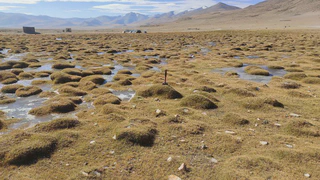 Photo credit: John Wani
Permafrost is defined as sub-surface material, excluding glaciers, having a temperature of less or equal to 0 °C for at least two consecutive years (ACGR, 1988, Van Everdingen, 2005).
Understanding permafrost dynamics is essential for predicting the future of high-latitude and high-altitude regions. However, for those new to the subject, finding the right entry point in the literature can be difficult.
In this post, I share my personal collection of foundational readings for beginners. These papers cover the essential definitions, the governing thermal physics, and the basics of permafrost modeling. Think of this as your essential reading list to build a strong theoretical framework before diving into complex modeling or fieldwork.
- Recent advances in permafrost modelling
- Permafrost distribution in the European Alps: calculation and evaluation of an index map and summary statistics
- A statistical approach to modelling permafrost distribution in the European Alps or similar mountain ranges
- GlobSim (v1.0): deriving meteorological time series for point locations from multiple global reanalyses
- A robust and energy-conserving model of freezing variably-saturated soil
- GEOtop 2.0: simulating the combined energy and water balance at and below the land surface accounting for soil freezing, snow cover and terrain effects
- Statistical modelling of mountain permafrost distribution: local calibration and incorporation of remotely sensed data
- Sensitivities and uncertainties of modeled ground temperatures in mountain environments
- Mountain permafrost: development and challenges of a young research field
- Permafrost and climate in Europe: Monitoring and modelling thermal, geomorphological and geotechnical responses
- Transient thermal effects in Alpine permafrost
- A method for solving heat transfer with phase change in ice or soil that allows for large time steps while guaranteeing energy conservation
- Implementing the Water, HEat and Transport model in GEOframe (WHETGEO-1D v.1.0): algorithms, informatics, design patterns, open science features, and 1D deployment
- Theoretical and numerical tools for studying the Critical Zone from plot to catchments
- Theoretical progress freezing-thawing processes study
- A sensitivity study of factors influencing warm/thin permafrost in the Swiss Alps
- Application of Satellite Remote Sensing Techniques to Frozen Ground Studies
- Derivation and analysis of a high-resolution estimate of global permafrost zonation
- How Much of the Earth’s Surface is Underlain by Permafrost?
- Influence of snow cover on ground surface temperature in the zone of sporadic permafrost, Tatra Mountains, Poland and Slovakia
- Influence of the seasonal snow cover on the ground thermal regime: An overview
- Mapping and modelling the occurrence and distribution of mountain permafrost
- Northern Hemisphere permafrost map based on TTOP modelling for 2000–2016 at 1 km2 scale
- Numerical simulations of the influence of the seasonal snow cover on the occurrence of permafrost at high latitudes
- Permafrost distribution modelling in the semi-arid Chilean Andes
- The changing thermal state of permafrost
- Permafrost is warming at a global scale
- The new database of the Global Terrestrial Network for Permafrost (GTN-P)
- Thermal state of permafrost and active layer in Central Asia during the international polar year
- Twenty years of European mountain permafrost dynamics—the PACE legacy
Additionally, you can find well-documented information on the long-term state and changes of mountain permafrost in the Swiss Alps through the Swiss Permafrost Monitoring Network (PERMOS). Also, they have documented and compiled best practice recommendations for the long-term measurement of permafrost temperatures.
Finally the permafrost Glossary 2025 (new) that will give you the definitions of the permafrost related terms.
Don’t forget to keep an eye on the International Permafrost Association (IPA) website for events and other stuff related to permafrost. Also subscribe to the Permafrost Young Researcher’s Network (PYRN), that promotes the future generation of permafrost researchers under the patronage of IPA.
