My research
I am an early-career researcher focused on the cryosphere, particularly snow and permafrost processes.
The challenge
Quantifying and predicting the response of the cryosphere (permafrost and snow) to climate change, and its impact on water resources and natural hazards.
The approach
Applying and developing physically based models, GEOtop and GEOframe, to bridge the gap between field observations and theoretical understanding.
The aim
Reducing uncertainty in water-resource predictions for high-altitude regions.
Research themes
Each theme lists its papers and blog posts.Permafrost and frozen ground
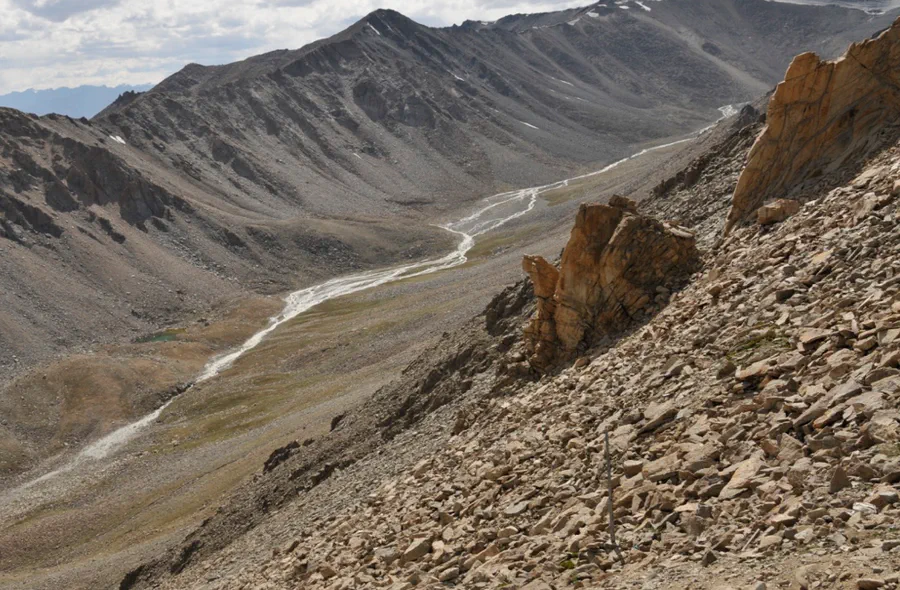
Permafrost (ground that stays at or below 0 °C for at least two consecutive years) underlies large parts of the cold-arid trans-Himalaya, yet it is almost unmonitored. In the upper Ganglass catchment of the Ladakh Range I combined field measurements, near-surface ground-temperature loggers spread between 4,700 and 5,612 m, with the GEOtop model to provide the first field-based permafrost characteristics for the Indian Himalayan region.
The results point to permafrost at all monitored sites above 4,900 m, with active layers from 0.1 to 4.2 m thick, sustained by a surface energy balance shaped by very dry air and strongly negative long-wave radiation. The same tools help explain hazards: in the 2021 Chamoli (Rishiganga) disaster, permafrost modelling suggested warm permafrost and conditions favourable for frost cracking at the source of the ice-rock avalanche.
Publications
On the blog
Mountain snow and water
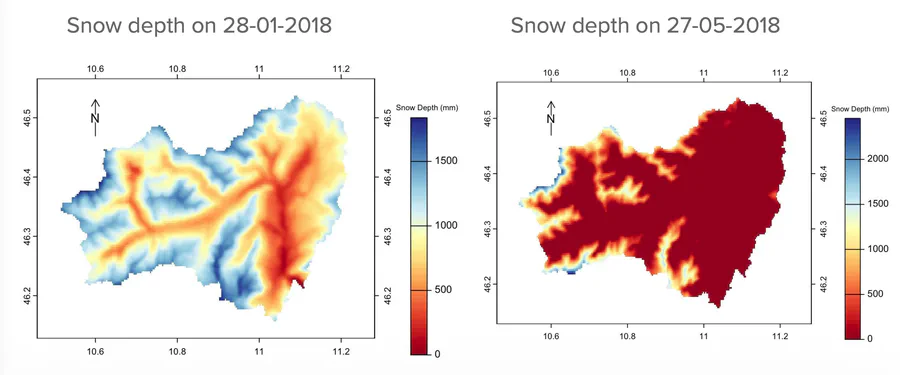
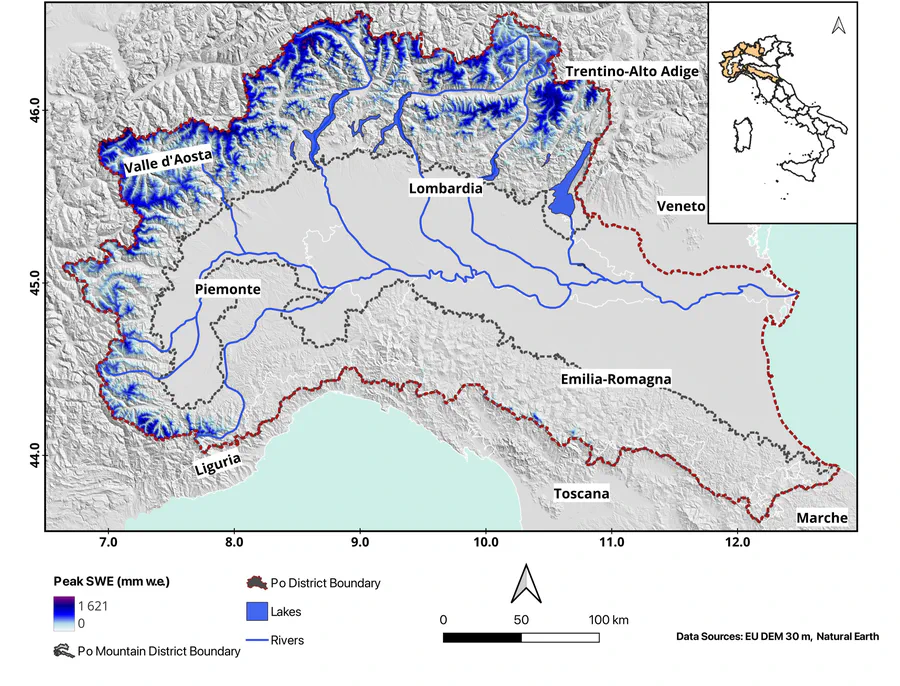
Seasonal snow is a natural reservoir that releases water to the valleys in spring and summer. With colleagues at Waterjade, the Po River District Authority and the University of Trento, I helped build a 30-year (1991–2021) snow water equivalent dataset for the Po River District at daily and 500 m resolution, combining the GEOtop model with in-situ snow observations and satellite snow products. The data are open on Zenodo.
Three decades of these maps show the largest losses of snow water storage below 2,000 m, where both snow volume and the length of the snow season decline. That shift matters for water availability and for monitoring snow drought in Italy’s largest river basin.
Publications
On the blog
Physics-based cryosphere models
I use and help develop open-source, physically based models: GEOtop, which couples the energy and water budgets at and below the land surface, and the component-based GEOframe system, into which I am integrating new process-based cryo-hydrological components.
Recent work derives the freezing of soil water from a single thermodynamic starting point, treating capillarity, dissolved solutes and adsorption as terms of one chemical potential. It also automates the calibration of 101 parameters of coupled heat-and-water permafrost models at boreholes near Hornsund, Svalbard. I teach these models in hands-on courses, from EGU in Vienna to ICIMOD in Kathmandu.
Publications
On the blog